Home / Books / The DEFEND Series / Teen Sextortion
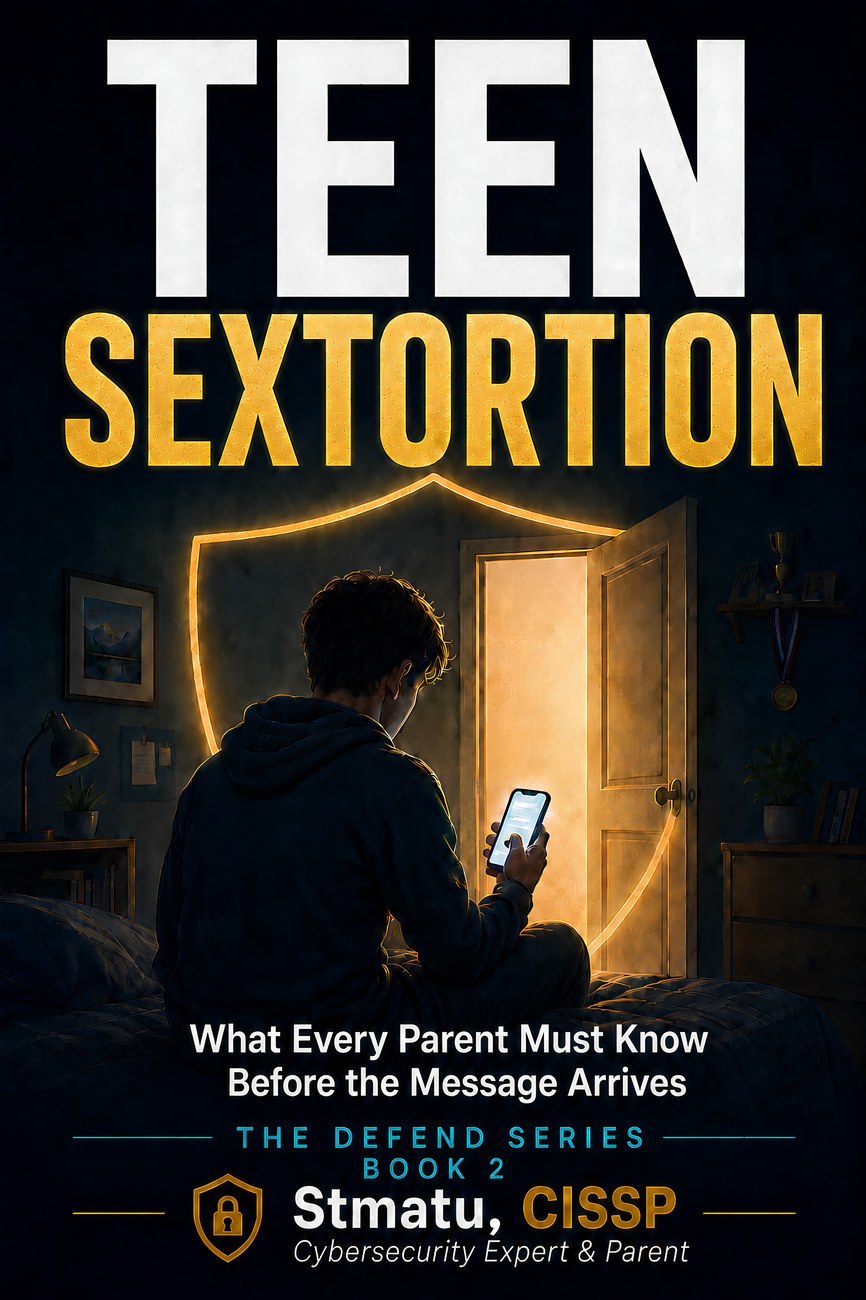
Teen Sextortion - What Every Parent Must Know Before the Message Arrives - Book 2 of The DEFEND Series
BOOK 2 OF THE DEFEND SERIES

Teen Sextortion

What Every Parent Must Know Before the Message Arrives

Author: Stmatu, CISSP
Format: Kindle & Paperback

Opens with a Crisis Quick-Start on page one.

Five steps, in order, before any theory — for the parent who found out ten minutes ago.

Buy on Amazon — Kindle $6.99 Paperback $14.99
📖 Available exclusively on Amazon · free to read on Kindle Unlimited

The STEER Framework

Five moves, one per chapter — from prevention to recovery.

  • See — what sextortion actually looks like, and how fast it escalates
  • Teach — the conversation that makes your teen tell you first
  • Evaluate — the warning signs a withdrawn teen is being extorted
  • Execute — the hour-by-hour response: safety, evidence, reporting, removal
  • Recover — rebuilding trust, and the long tail afterwards

About This Book

The message arrives at 11pm, and your teen has already been paying for three days.

Sextortion is not a distant internet danger. NCMEC logged more than 50,000 financially motivated sextortion reports in 2025 — roughly 137 every day — and teenage boys are the most common targets. Most parents never see it coming, because the child hides it out of shame long before anyone else notices.

Here is the hard part: in this specific crisis, a parent’s instincts are almost exactly wrong. We want to ask what our child did. We want to grab the phone. We want to make it disappear. Each of those makes it worse.

Teen Sextortion is written for the parent who needs to act correctly in the next ten minutes — and for the parent who wants to make sure this never gets that far. It opens with a Crisis Quick-Start on page one, before any theory, and then moves through the STEER framework: see it clearly, teach and protect, evaluate the warning signs, execute the response, recover and rebuild.

Includes reporting directories, conversation scripts, a digital evidence log, age-specific guidance, and step-by-step image-removal instructions using NCMEC’s Take It Down.

Your teen is not in trouble. They are the victim of a crime. This book is how you prove that to them, and what to do next.

Read the Opening

From the Introduction — The Threat Hiding in Your Teen’s Phone

The reality no parent wants to face.

Somewhere tonight, a teenager is sitting in a locked bedroom, phone buzzing, staring at a message that says: send more, or pay, or everyone you know will see. They are not a reckless kid or the child of careless parents. They are ordinary — a good student, a gamer, someone’s first crush — and in the space of a single evening, a stranger or a peer has turned one image into a weapon.

This is sextortion: using a sexual image to blackmail someone into providing more images, money, or compliance. It is different from most online dangers you have prepared for. It moves fast, it runs on shame, and it aims at the one thing a teenager cannot bear — the fear of being exposed to everyone they know. And it is not a problem that only touches “other families.” It reaches across every income level, neighborhood, and kind of household, because the only thing it requires is a teen with a phone.

Most parents’ instincts are exactly wrong for this particular crisis. We want to ask what our child did. We want to grab the phone and fix it. We want to make the threat go away by giving it what it asks for. Every one of those instincts makes sextortion worse. This book replaces instinct with a plan.

Continue Reading on Amazon — $6.99

If this is happening right now

You do not need the book to take the first steps. These are the same channels it sends you to — and the first thing to tell your teen is that they are not in trouble.

  • Immediate danger or risk of self-harm — call 911, or call/text 988 (Suicide & Crisis Lifeline).
  • Report it — NCMEC CyberTipline, report.cybertip.org or 1-800-843-5678. The FBI: tips.fbi.gov or 1-800-CALL-FBI — use ic3.gov for financial extortion.
  • Get the image taken downtakeitdown.ncmec.org for images of someone under 18. It fingerprints the file on your teen’s own device; the image itself is never uploaded. For images made at 18 or older, use StopNCII.org instead.
  • Never download, forward, or request a copy of the image just to submit it — if you don’t already have it, report to the CyberTipline instead.
  • Do not pay, and do not delete anything. Paying invites more demands; the messages are the evidence.

The rest of The DEFEND Series

Three books on family cybersecurity, each one threat at a time. Deepfakes Exposed covers the faked face and image; The Cloned Voice covers the faked voice on the phone.

See all three books The Is AI Replacing Parenting? series